


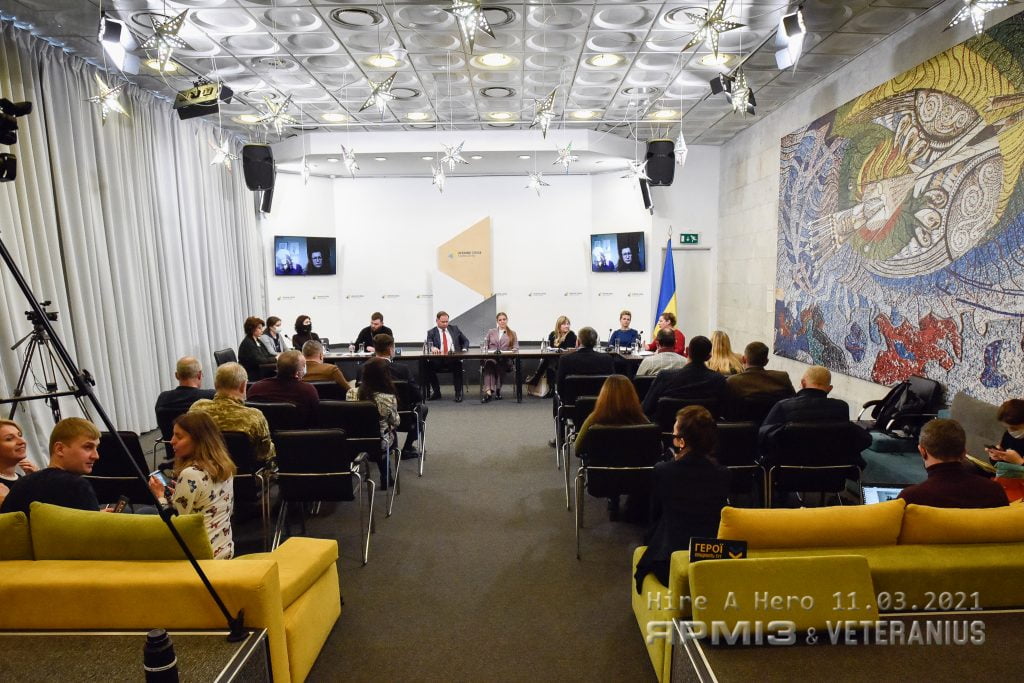
The Crisis Media Center hosted a cross-sectoral panel discussion “Hire a Hero. From Demobilization to Reintegration” on March 11. The event took place in partnership with the YARMIZ Rehabilitation and Adaptation Center, Razom NGO (USA) and the Veteranius project.
Liuba Shypovych, Co-Founder and Vice President of Razom NGO (USA), Veteranius Project Manager opened the discussion by outlining the problem of training and retraining war veterans.
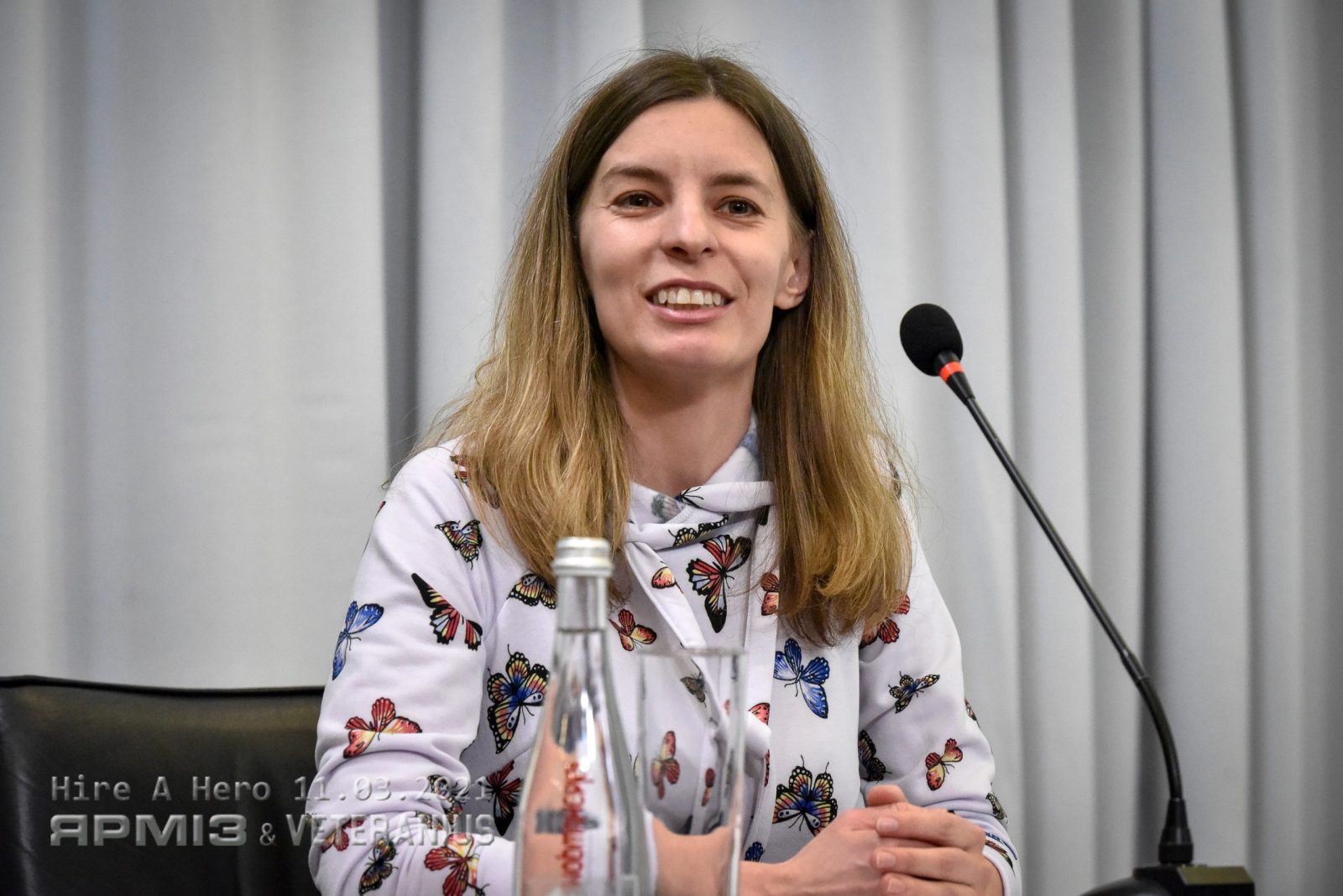
The public sector was represented by Oleksii Illiashenko and Volodymyr Levchuk, Deputy Ministers for Veterans Affairs of Ukraine, also by Svitlana Startseva, Acting Director of the Department of Housing Policy and Public Works of the Ministry of Development of Communities and Territories of Ukraine
"The issue of transition from a military career to civilian life is one of the key issues addressed by the Ministry of Veterans Affairs. It is multifaceted and includes a wide range of aspects - psychological support and rehabilitation, work with families, social protection, professional readaptation, retraining and much more. Today, the key programs for the ministry are increasing the competitiveness of veterans in the labor market and assisting in veteran entrepreneurial initiatives”, — emphasized Volodymyr Levchuk, Deputy Minister of Veterans Affairs of Ukraine for digital development, digital transformations and digitization.

Oleksii Illiashenko, Deputy Minister for Veterans Affairs of Ukraine for European Integration, highlighted the other part of the issue: “When Ukraine started working on a draft Association Agreement with the EU, the actual Ministry did not yet exist. This also applies to the Ukraine-NATO Program. Now we are changing all the approaches. Up to 20 items on education, employment and other involvement of veterans in public life appeared in the NATO-Ukraine Annual National Action Program for 2021, compared to not even 1% before”.".

T.v.o. Svitlana Startseva, director of the Department of Housing Policy and Improvement of the Ministry of Community and Territorial Development of Ukraine, said that one of the areas that can be useful for attracting veterans is the housing and communal sector. The energy efficiency fund has a significant amount of funds from the state budget and from international organizations, which are inactive due to lack of demand. Veterans who have a significant credit of trust from society could be managers of condominiums, designers, energy auditors. The Ministry has already developed short-term training courses in various specialties. "We are ready to provide business building mechanisms in this area. If veterans organize such a business and cooperate with local self-government bodies, this will have a positive effect for the community in general, as well as for the housing stock that is located in this areaSvitlana Startseva said.

Representatives of veteran organizations spoke from the public sector.
In contrast to the positive forecasts voiced by the representatives of the ministries, the head of the NGO "United by war. 90th Battalion", veteran Vitaly Baranov expressed the opinion that despite the large number of declared good ideas and initiatives, veterans do not see the results of state programs, especially those veterans who live in rural areas. "If we solve the social problems of veterans, we will solve half of the psychological onesVitaliy Baranov emphasized.


Volodymyr Mostoviy, head of the Federation of Non-Governmental Organizations of ATO/OOS participants of Kyiv Region, head of the GS, a veteran, also pointed out significant shortcomings of the authorities in this direction. "Compliance with many benefits for combatants is entrusted to local authorities. And we have districts that are generally subsidized. How can they fulfill these social guarantees of veterans?", he emphasized.

Veterans include people with disabilities, single mothers, people who have adopted a child and other privileged categories. The head of the NGO "Women's Veteran Movement", veteran Andriana Arekhta, updated that it is twice as difficult for female veterans to find a job, because the burden of military experience is added to the discredit due to gender. According to her, many women do not even mention military experience in their resumes. Women with disabilities due to injuries received during hostilities have even greater problems with employment.
Olesya Perepechenko, executive director of the GS "Modern View" added: "In order to get a job, a person with a disability needs to be a head smarter than a person without a disability, which is 100 percent. But it is also important to educate, teach, rehabilitate society itself towards people with disabilities".
"Indeed, we must state that society lacks a clear understanding of how to combine social and economic measures to support the employment of combatants in the private sector. The only thing proposed by law is quotas and material incentives for employers who employ combatants from among the unemployed. But in this algorithm of employment of persons who use separate guarantees, the emphasis is lost on the main thing - on qualifications, skills and abilities", explained Olga Makogon, Director of the State Employment Service of Ukraine 2019-2020. A private employer is looking for workers who will meet its conditions. Among the achievements of the State Employment Service, Olga Makogon spoke about the introduction of a separate Institute of Career Adviser. Its main goal is to build a bridge between employers looking for workers and the unemployed, including veterans looking for work.

Representatives of the education sector - Tetyana Izmailova and Serhiy Gvozdiov from the Kyiv School of Economics and Oksana Chub from the Kyiv National University of Economics named after Vadym Hetman, director of the Center for Relations with Employers and Student Employment Promotion, emphasized qualifications, skills and abilities, rather than the presence of a special social status "Prospect". Based on the research of Professor Anatoly Kolot "SPHERE OF WORK IN THE CONDITIONS OF GLOBAL SOCIO-ECONOMIC REALITY 2020: CHALLENGES FOR UKRAINE. Labor 4.0", Oksana Chub also emphasized the specificity of modern market conditions. "Work ceased to be unified when we were tied to a certain workplace. Today there is such a concept as "hybridization" - a combination of online and offline formats. We combine formats and distances. Here and now - recedes into the background. The labor market is becoming global, where we can carry out our professional activities without territorial limitations."

A veteran, a graduate of the "Veteranius" project, Maksym Nazaruk, who after returning from the front mastered the IT field and launched his own startup, shared his own successful case regarding the role of education and retraining. "A military man is a person who knows how to manage his time and organize the effective use of time in his unit. Also, the military knows how to handle large data sets and perform the most responsible work. But it is very important that a military person always has a mentor by their side during the training process, who will tell them where to move, what tools need to be mastered, a person who will "lead the veteran by the hand”, — Maksym Nazaruk is confident.

"Veterans are actually a great potential and they are people who have already proven their devotion to the country. We don't want it to be a problem, or some obscure benefits. We want the state, business, and veteran organizations to work together on the reintegration and resocialization of veterans- emphasized Yaroslav Lepyavko, mentor of the "Veteranius" project, executive director of the veteran IT company DataOcean.

Larisa Bulatova, director of the national outdoor advertising operator "Perechid Outdoor" told about the position of business in relation to the issue of employment of veterans: "As for the employment of veterans, we do not distinguish these categories. If we have vacancies for sales managers, SMM or accountants, we don't look at who applies. Qualifications, professional skills, experience and desire to develop are important to us. It seems to me that stigmatization is the first step to discrimination."

From the international expert sector, representatives of IREX in Ukraine, the Renaissance Foundation and the Friedrich Ebert Foundation in Ukraine attended the event.
Maria Berlinska, coordinator of the veterans reintegration program of the International Organization IREX in Ukraine, emphasized:Only by combining the efforts of the state, the public sector and international support can we move forward. The war continues. It is good that there is an understanding at the highest level that the issue of reintegration of veterans is not one year, and not even one decade. We should prepare not for a sprint, but for a marathon".

Margarita Lytvyn, coordinator of the "Tolerant and Inclusive Society" direction of the Friedrich Ebert Foundation in Ukraine, raised the topic of the need to change society's consciousness: from shifting responsibility and finding the guilty to local steps and small shifts.

For her part, Olga Galchenko, coordinator of the "Human Rights and Justice" program of the International Renaissance Foundation, expressed the opinion that veterans on the ground should use the advantages of decentralization and cooperate with local authorities: "Veteran centers on the ground need to seek cooperation with local authorities and come together on joint projects ".
Today's labor market depends on legislative initiatives, economic conditions, tax policy, international assistance in the form of experience, advice, and know-how, employee qualifications, employer requirements, and other external and internal factors. All of these factors together affect the status and employment opportunities of veterans after demobilization.
"For the YARMIZ Center, today's event is a successive step in the implementation of the strategic program for the creation of the Creative Hub and the beginning of the practical activities of the Career Center. Real changes in the fight against unemployment and employment of veterans are possible only if all sectors: government, education, business and efforts of the public sector to implement a culture of uniting for a constructive dialogue.
Together with other organizers, I propose to consider this meeting as a founding one. Subsequent meetings should be narrowly specialized, focused on specific tasks and solution plans, inviting relevant parties", concluded Yevgenia Gubska, Director of the Center for Readaptation and Rehabilitation of YARMIZ.
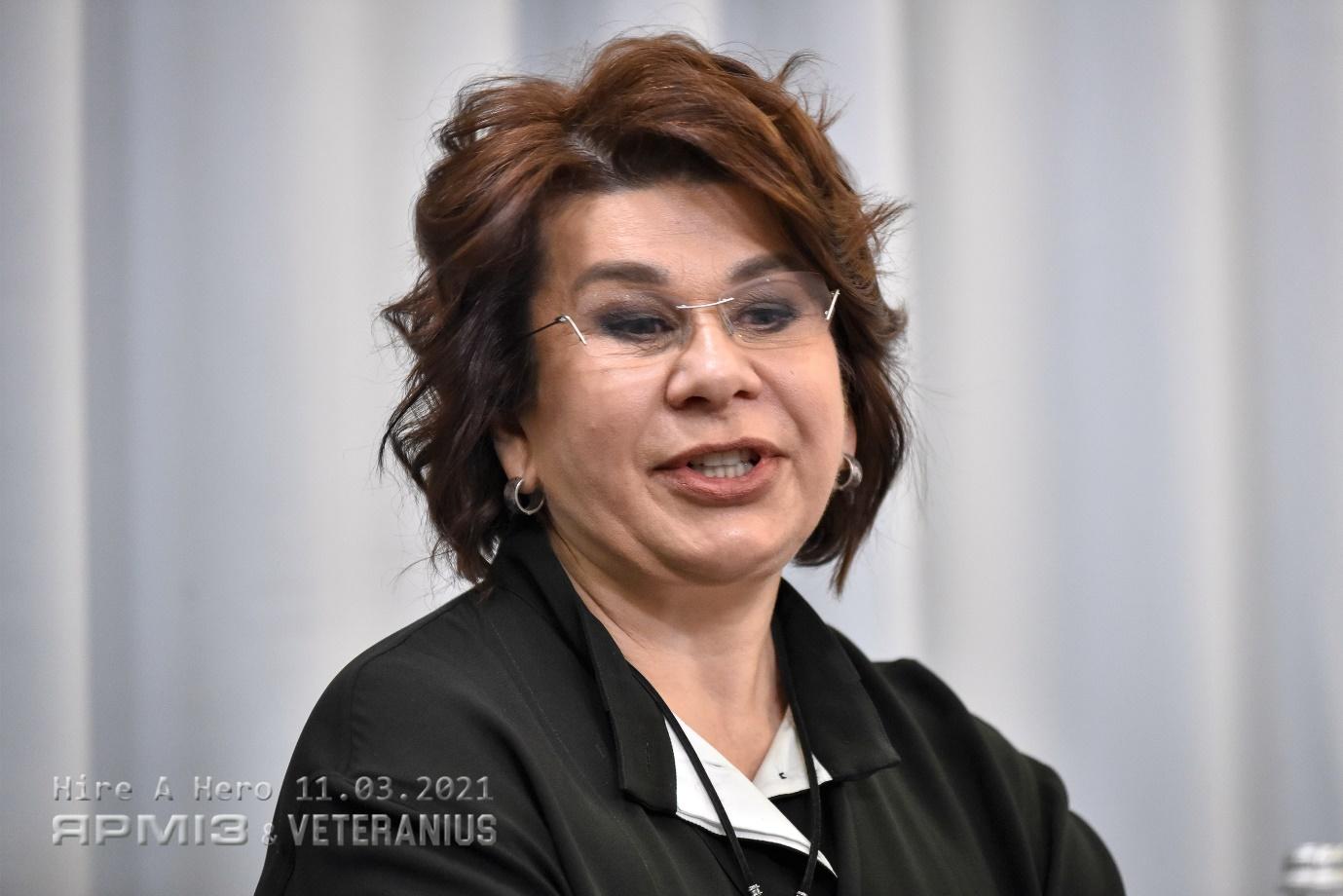
The discussion of future cooperation plans continued in the networking format.