


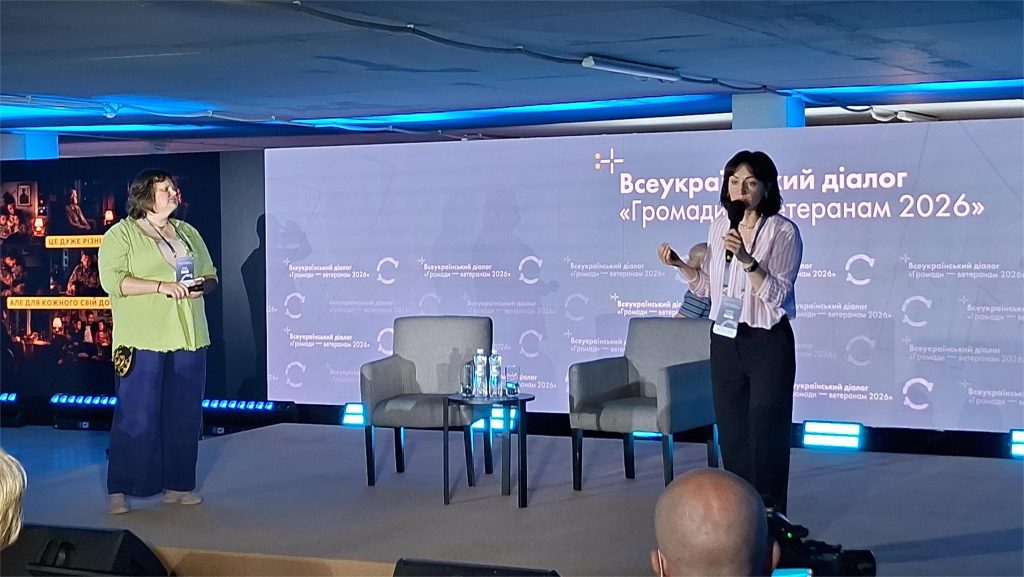
The V All-Ukrainian Dialogue "Communities for Veterans - 2026" became an opportunity to see and discuss what is happening today in the state, communities, and individual organizations to support defenders and their families.We see that there are already many solutions that work. Even more that need to be developed, refined, and implemented. And this is a natural part of the process of building an effective support system.
At the same time, such meetings provide an opportunity to draw attention to the people who maintain this system on a daily basis, implement and implement specific services. After all, it is precisely on the specialists on the ground that it depends on how a particular service will work, how accessible, effective it will be, and how it will correspond to the idea with which it was created.That is why during the workshop "Ukrainian experience in restoring mental health and supporting specialists in this field" Olga Kuharuk and Maryna Syritsa, as representatives of the team ЯРМІЗ, spoke about the importance of building a system focused not only on defenders and their families, but also on the professionals who work for them.We must take into account that we all live in war and have our own experiences that affect us and our interactions with others. This is especially true for professionals who often come into the profession with a high level of caring, strong values, and a motivation to help. At the same time, many of them have their own difficult war experiences: participation in combat, waiting for relatives from the front, losses, forced displacement, or a combination of several such experiences. This becomes both a source of strength and a point of vulnerability.Therefore, the veterans support system must take into account not only the needs of service recipients, but also the experience, resourcefulness, and professional capabilities of those who provide these services.One solution could be to implement a trauma-informed approach as a system-building principle for organizing care. Its key principles – safety, trust and transparency, supporting choice, collaboration, strengthening capacity and taking into account different experiences – are equally important for both service recipients and their providers.Safety must be ensured for both the veteran and the professional. Transparency is important not only in receiving the service, but also in organizing the work of the professional. We need to recognize and strengthen the capacity of defenders, but it is equally important to recognize the contribution and support the capacity of those who work for them.We must recognize that building such a system requires additional resources, time, and effort. However, this is precisely what creates the foundation for its sustainability and effectiveness in the long term.Today, much attention is paid to services, solutions, and social support for veterans. When designing them, it is taken into account what exactly the veteran will receive and what path he must take to receive assistance. Much less attention is paid to those who will implement these solutions on a daily basis.
For the system to work effectively, the role of the specialist, his/her resources, physical and psychological capabilities, and professional needs must become as important a part of planning as the needs of the veteran. After all, caring for those who support others is not an optional extra. It is a necessary condition for a sustainable support system.